Showing posts with label Calculators. Show all posts

Tuesday, May 27, 2008

What is Financial Planning?

During my blogging hiatus, my life has encountered a few changes. One major change being that I'm now 2 months into my new job in - can you guess? - publishing! (See long story here & mid-way report here.) Having taken into account the state of starter salaries in the publishing industry (dismal), I've also kept my seasonal job. And if I may confess, although 6-day weeks have become typical for me, I still occasionally quite often toy with the idea of quitting my part-time job. But that's a story for another day...

Last week, after 2 months of waiting for direct deposit, 401(k) and FSA deductions to be activated, I was finally able to figure out my cash flow and craft a simple spending plan. (Note: While I enjoy using Excel to better manipulate my data, I highly recommend YahooFinance's cash flow calculator.) I'm really excited to report that I'm currently saving 60% of my paycheck! Of course, that includes allotments for my new 401(k) plan, and House, Investment, and Savings funds.

One of my primary concerns in the last two years has been being my own financial planner. I found that my focus shifted as I went through various stages of employment. When I was working full-time, I focussed on:

While I was unemployed and the economy took a downturn, my focus shifted to:

  • Investment review
    Including: diversifying my portfolio, weighing the trimming of riskier stocks with acquiring "discounted" stocks
  • Insurance needs
    A piece of advice from someone who decided to forgo this - health insurance is something everyone should have. If you ever find yourself without health insurance, pay for COBRA, sign up for HealthFirst. Do what you need to in order to be insured - it's worth the peace of mind of knowing you can get sick!
  • Funding future education
Some present (and ever-present) concerns include:

  • Cash management: emergency fund, spending (including price shopping, impulse shopping, setting credit/cash/spending limits)
  • Diversification: During the market flux, my networth moved in tandem with the erratic stock market - a sure sign that I needed to spread my eggs in different baskets!
  • Estate planning: a will, a living will, power of attorney of healthcare
  • Tax planning

As I continue to plod along in my quest to be an efficient financial planner for moi, I'm sure my priorities will continue to shift as well. Goals like buying a house will definitely open up worlds of concerns. But with the wealth of information available, I'm sure I'll be able to muddle through somehow. What concerns have you had as you moved through various stages of employment and life?

Tuesday, November 13, 2007

True Cost to Own

While car shopping over two years ago, I came to be a passing acquaintance of Edmunds.com. I cann't pretend I know all of Edmunds features, but one that I found (and continue to find) uber useful is their True Cost to Own estimator. In their own words, TCO "helps you estimate the total five-year cost of buying and owning a vehicle - including some items you may not have taken into consideration."

Of course, as with all generalizations, the TCO calculator must make certain assumptions, such as:

  • average annual mileage is 15,000 miles;
  • the buyer is financing the vehicle using traditional financing, not lease financing;
  • the buyer is "in the Gold credit tier";
  • the buyer is putting a 10% down payment on vehicle; and
  • the retail contract term is 60 months.
Overall, the TCO calculator helps to compare the cost of a car over the span of five years by comparing your estimated costs in seven specific categories:
  1. depreciation
  2. insurance
  3. financing
  4. taxes & fees
  5. fuel
  6. maintenance
  7. repairs
For a more detailed breakdown of associated costs, see here.

And while it doesn't claim omniscience, the TCO calculator does at least serve as a reminder of the costs of new car ownership. As Edmunds.com says, "A benefit of using this tool is that you can...make a more informed choice."

Monday, February 12, 2007

Analyzing CD Terms

The Yahoo! Finance CD Analyzer is, by far, my favorite CD interest calculator. Not only does it tell you how much interest you will earn, this calculator also takes into account your tax bracket, so you can see the tax bite of your CD investment as well.

This month, my local WaMu branch has a 10-month CD with 5.28% APY. Being in the 25% tax bracket, this CD would translate for me thus:


With multi-year CD's, this calculator also provides an accompanying graph listing each year's tax bite. Even though you can pencil & paper this math, a nifty online calculator makes it so much faster, doesn't it? The only drawback is that you must remember to input the CD's APR, not its APY.

Tuesday, February 6, 2007

Reality Check Anyone?

ISPF's blog led me to a Reality Check calculator, where I projected myself into a one bedroom apartment with internet, but no cable or landline. And aside from getting rid of my car and adopting public transportation, my projected lifestyle stayed pretty much the same: savings, minimal shopping, no movie dates, basic hygiene like shampoo & an occasional haircut, but no manicures, and reading online instead of print materials. Oh, and I optimistically projected myself into cooking at home - since that's only my biggest splurge right now.

The calculator says I should make at least $9.00/hour. I don't think this calculator has taken into consideration the cost of living in NYC. I've managed to save enough to increase my networth by 58% since May 2006, but I've done the math before: had I moved out once I had a full time job (and hence, started saving regularly), my entire savings account in ING Direct would have been called "Rent Fund" instead of "Savings." And I make quite a bit more than $9.00/hour.

Conclusion: Another reason to be satisfied with living at home!

Thursday, January 4, 2007

Find your Wealth Score

According to Liz Pulliam Weston, one's wealth score is the indicator of a (wo)man's financial progress. It's an easy, 3-step process that looks like this:

  1. Add up lifetime earnings...put away the calculators please, this figure can be found on your yearly Social Security statement.
  2. Calculate your networth.
  3. Divide your networth (#2) by your lifetime earnings (#1).

As you get older and progress in your career, your desired ratio should increase accordingly. Per a financial planner that Pulliam consulted, the recommended ratios are as follows:

Early career0-25%
Mid-career25-100%
Close to retirement100-200%

Having saved this MSN Money article since it was first published, I am now armed with my SS statement and able to put this simple calculation to use. And now, without further ado, my current wealth score is in....drumroll please!....the mid-career range! Now that's encouraging.

Sunday, December 31, 2006

Bagged Lunch


I'm a worrywart. That's the only explanation I can grasp to justify why I am suddenly concerned about how much more lunch money I will potentially be spending when I find a new job this year. (Hopefully, within the first quarter of 2007.)

According to LunchSaver, I have saved approximately $5,000 on lunch at my current job. $10 is a hefty estimate, but since I'd be spending at least 20 minutes worth of gas, mileage and time on top of actually eating, I inflated the cost of lunch by a few dollars.

I'm concerned about overspending on lunch at a new job that I haven't applied to much less found yet at 2:54am on a Sunday morning. My name is _ and I. Am. A worrywart.

Wednesday, September 13, 2006

Re-balanced 401(k)

When I started my first full-time job after college, the most insistent advice I got was to contribute to my 401(k). "Isn't that for retirement?" I asked incredulously...but I contributed anyway, because I figured that refusing the employer match is like giving away money to Bill Gates. (And I'm no Warren Buffett.)

I'm currently putting away a little over 18% of each paycheck to my 401(k), to stay in a retirement fund until at least 2042. But I'm still not sure what make of my portfolio. An article from Money Magazine lends to a basic understanding, saying that a 10% contribution is "good." (Does this mean I should scale back on my contributions? Then I'd lose the employer match of 37.5% on 4% - which really means 1.5%, so why don't they just say that - better a measly match than none at all?)

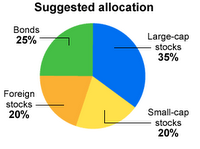
Asset Allocation GraphThe guide suggests certain funds: the "Indexes," and funds with low expense rations (basically, funds labelled "Small-Cap Value" or "Large-Cap Growth"). And it also suggests using a risk assessment calculator, which churned out the suggested allocation on the right.

Somehow, the fund performances in my company's 401(k) can't convince me to adopt these percentages. Instead, I've re-balanced to: 15% in large-cap stocks, 20% to small-cap and specialty stocks, and 45% in foreign stocks. (I hope markets outside the States keep it up!)

And that's my newly balanced and re-aligned 401(k). I'm also looking into a Roth IRA right now. (PTF)