Showing posts with label Retirement. Show all posts

Tuesday, May 27, 2008

What is Financial Planning?

During my blogging hiatus, my life has encountered a few changes. One major change being that I'm now 2 months into my new job in - can you guess? - publishing! (See long story here & mid-way report here.) Having taken into account the state of starter salaries in the publishing industry (dismal), I've also kept my seasonal job. And if I may confess, although 6-day weeks have become typical for me, I still occasionally quite often toy with the idea of quitting my part-time job. But that's a story for another day...

Last week, after 2 months of waiting for direct deposit, 401(k) and FSA deductions to be activated, I was finally able to figure out my cash flow and craft a simple spending plan. (Note: While I enjoy using Excel to better manipulate my data, I highly recommend YahooFinance's cash flow calculator.) I'm really excited to report that I'm currently saving 60% of my paycheck! Of course, that includes allotments for my new 401(k) plan, and House, Investment, and Savings funds.

One of my primary concerns in the last two years has been being my own financial planner. I found that my focus shifted as I went through various stages of employment. When I was working full-time, I focussed on:

While I was unemployed and the economy took a downturn, my focus shifted to:

  • Investment review
    Including: diversifying my portfolio, weighing the trimming of riskier stocks with acquiring "discounted" stocks
  • Insurance needs
    A piece of advice from someone who decided to forgo this - health insurance is something everyone should have. If you ever find yourself without health insurance, pay for COBRA, sign up for HealthFirst. Do what you need to in order to be insured - it's worth the peace of mind of knowing you can get sick!
  • Funding future education
Some present (and ever-present) concerns include:

  • Cash management: emergency fund, spending (including price shopping, impulse shopping, setting credit/cash/spending limits)
  • Diversification: During the market flux, my networth moved in tandem with the erratic stock market - a sure sign that I needed to spread my eggs in different baskets!
  • Estate planning: a will, a living will, power of attorney of healthcare
  • Tax planning

As I continue to plod along in my quest to be an efficient financial planner for moi, I'm sure my priorities will continue to shift as well. Goals like buying a house will definitely open up worlds of concerns. But with the wealth of information available, I'm sure I'll be able to muddle through somehow. What concerns have you had as you moved through various stages of employment and life?

Friday, July 13, 2007

Your Gucci or Mine?


After attempting the challenging read of Malkiel's investment classic, I opted for some light personal finance reading by David Bach. In Smart Couples Finish Rich, he stresses a very important principle:
"Money is a vehicle for our values and the goals that help us live those values."
I'm sure we all couldn't agree more. But am I the only one who finds it hard to adhere to that principle when you can't help but run into at least 7 Gucci's or Kate Spade's within a half hour on Broadway in SoHo? Trust me, I was there two nights ago - I counted. (And I was standing in a fixed spot, not trolling for luxe bags!) There's no harm in admiring a nice bag...as long as I haven't sacrificed $67k in retirement savings to own it, right?

What Does It Take to Be Rich (link):
"In the end, of course, what it takes to feel 'rich' today, or even merely comfortable, is largely a matter of personal perception.

"Kathy Shoeny is a single mother in El Monte whose income drops her squarely into the ranks of the working poor by government standards. But she owns a small home, a car, two TVs, a VCR and a computer. Her two children have health insurance and decent schools. She has a job decorating cakes at a bakery. "She occasionally dreams about what her life would be like if she won the lottery--an impossibility, she says, because she never plays--but has concluded she’s already pretty rich. " 'I’ll admit to feeling some pangs of jealousy when I read about 'wealthy' people and their 'problems,' " Shoeny said. 'However, what I mostly feel is incredulity.' "
Jealousy? Sometimes. But it's easier to overcome those few moments when I know that I will be able to reach my financial goal of supporting myself adequately later in life. And it always feels way better to simply admire someone else's arm candy than to get one for myself & fret about how much buying a bag has cost my retirement!

Thursday, February 15, 2007

Target Retirement Fund 2045

Welcome...you're reading the blog of a proud new owner of a Roth IRA!

Two days ago, I opened a Vanguard account & max'ed out my Roth for 2006, not mention a small headstart on 2007. I contributed just enough to avoid Vanguard's low balance fee ($10 for accounts under $5,000). It takes about ten two days for my Vanguard account to be funded through my checking account, so now I'm just waiting to see how many shares of Vanguard's TRF 2045 I'll actually own.

Somehow, a lifecycle fund escapes any previous trepidation I had regarding investing...must be some inherent trust I place in "the experts" more than being my own stock picker/portfolio manager. At any rate...That's one thing off my Goals sidebar!

Friday, January 12, 2007

Let's pretend...

...for the sake of Jan. 26th's Carnival of Under 30 Finances, that:

I am a 25-year-old with a $25k student loan. I have been given $10k, but I can only use the entire $10k towards one of the following items:

  • invest it for retirement funds
  • save/invest it for a future home
  • save/invest it towards a child's/children's future college education
  • pay part of student loan debt.

Assuming that the rate of return on the three investments is equal, and that my student loan charges an interest rate equal to this rate of return, which would I pick and why?

Would my answer be any different if the amount was $25k instead of $10k?

My first inclination would be to pay my student loan. I'm always leery of accruing any debt that I can't immediately pay off. When it came to paying for a college degree, my saving grace was that my parents partially financed my education so that my loan wouldn't be quite so astronomical.

To follow this line of reasoning, I'd be even happier if I received $25k to pay my debt in full! Then, my future pay would be socked away for retirement and a future home. I'd save for the kids' college fund too, but not before retirement, since student loans are easier to get and cheaper to pay off than retirement loans! If they existed. So that's what I'd do. Boring but true.

What would you do?

Thursday, January 4, 2007

Find your Wealth Score

According to Liz Pulliam Weston, one's wealth score is the indicator of a (wo)man's financial progress. It's an easy, 3-step process that looks like this:

  1. Add up lifetime earnings...put away the calculators please, this figure can be found on your yearly Social Security statement.
  2. Calculate your networth.
  3. Divide your networth (#2) by your lifetime earnings (#1).

As you get older and progress in your career, your desired ratio should increase accordingly. Per a financial planner that Pulliam consulted, the recommended ratios are as follows:

Early career0-25%
Mid-career25-100%
Close to retirement100-200%

Having saved this MSN Money article since it was first published, I am now armed with my SS statement and able to put this simple calculation to use. And now, without further ado, my current wealth score is in....drumroll please!....the mid-career range! Now that's encouraging.

Sunday, December 31, 2006

The SSA Knows My Name

I'm 24 years old, and I was excited to finally receive my first Social Security Statement in the mail. Color me crazy.

The statement outlines my past income, the credits of work I've accumulated, and the $ my hypothetical surviving spouse and unborn children would get upon my hypothetically untimely demise this year. Every $970 of income qualifies you for 1 work credit, and you can earn up to four credits a year. To collect retirement benefits, you would need to accumulate 40 credits. SS benefits (retirement, disability and survivor) are determined based on your 35 highest-grossing years. That's the short version.

But what intrigues me is the disclaimer on the statement:

"The law governing benefit amounts may change because, by 2040, the payroll taxes collected will be enough to pay only about 74 percent of scheduled benefits."
It seems I should have paid more attention a while back, when the big social security crisis stories first hit the airwaves. Call me crazy, but 74% of something is better than 0% of nothing...isn't it? Besides, being young and (fortunately) able-bodied at the time of this post, I'm imbued with the optimism of youth that I'll make it big by the time I retire, and hence, Social Security will be but a drop in my retirement bucket.

Friday, December 29, 2006

Keep your IRA records until you withdraw...

...and throw away year-old bank statements!

Back from my 3-week vacation to HK...which, in case you're wondering, was totally worth the full year I spent saving up! Anyway, Bankrate has this nifty article in time for those who like to clean up their financial records at the close of every year:


Type of recordLength of time to keep -- and why

Taxes

Canceled checks/receipts (alimony, charitable contributions, mortgage interest and retirement plan contributions)

Records for tax deductions taken

Seven years

The IRS has three years from your filing date to audit your return if it suspects good faith errors.

The three-year deadline also applies if you discover a mistake in your return and decide to file an amended return to claim a refund.

The IRS has six years to challenge your return if it thinks you underreported your gross income by 25 percent or more.

There is no time limit if you failed to file your return or filed a fraudulent return.

IRA contributions

Permanently

If you made a nondeductible contribution to an IRA, keep the records indefinitely to prove that you already paid tax on this money when the time comes to withdraw.

Retirement/savings plan statements

From one year to permanently

  • Keep the quarterly statements from your 401(k) or other plans until you receive the annual summary; if everything matches up, then shred the quarterlies.
  • Keep the annual summaries until you retire or close the account.

Bank records

From one year to permanently

  • Go through your checks each year and keep those related to your taxes, business expenses, home improvements and mortgage payments.
  • Shred those that have no long-term importance.

Brokerage statements

Until you sell the securities

You need the purchase/sales slips from your brokerage or mutual fund to prove whether you have capital gains or losses at tax time.

Bills

From one year to permanently

  • Go through your bills once a year.
  • In most cases, when the canceled check from a paid bill has been returned, you can shred the bill.
  • However, bills for big purchases -- such as jewelry, rugs, appliances, antiques, cars, collectibles, furniture, computers, etc. -- should be kept in an insurance file for proof of their value in the event of loss or damage.

Credit card receipts and statements

From 45 days to seven years

  • Keep your original receipts until you get your monthly statement; shred the receipts if the two match up.
  • Keep the statements for seven years if tax-related expenses are documented.

Paycheck stubs

One year

  • When you receive your annual W-2 form from your employer, make sure the information on your stubs matches.
  • If it does, shred the stubs.
  • If it doesn't, demand a corrected form, known as a W-2c.

House/condominium records

From six years to permanently

  • Keep all records documenting the purchase price and the cost of all permanent improvements -- such as remodeling, additions and installations.
  • Keep records of expenses incurred in selling and buying the property, such as legal fees and your real estate agent's commission, for six years after you sell your home.
  • Holding on to these records is important because any improvements you make on your house, as well as expenses in selling it, are added to the original purchase price or cost basis. This adds up to a greater profit (also known as capital gains) when you sell your house. Therefore, you lower your capital gains tax.
Source: Marquette National Bank and Catherine Williams,
President of Consumer Credit Counseling Services of Greater Chicago

Tuesday, November 28, 2006

To Roth or Not to Roth?

After doing a bit of research on the Roth IRA, I've learnt that I should stick to my 401(k) contributions after all. The employer match is free money, right? Evenutally, though, I'd still like to save enough for retirement to contribute to both...as of now, however, I don't even max out my 401(k) yet. But I will be keeping my eye on a certain target retirement fund, just in case.


For future reference:

  1. Complete Guide (Fairmark)
  2. Retirement Guides (SmartMoney)
  3. Update: (CNNmoney)

Thursday, October 12, 2006

The Under 30 Honor Roll

"For the Under 30, By the Under 30."

Started by Kira, the Honor Roll's tagline says it all. The blogging network posts articles pertinent to twenty-something's, featuring financial how-to's that discuss topics like student loans, credit cards, budgeting, saving, investing, charity-giving, buying & owning a car or a home, taxes, and more. That being said...

...today is my first day as a member of the Under 30 Honor Roll!


And I also joined Kira's brainchild, CashDuck!

And in case you're interested in my progress on Cashduck...

Wednesday, September 13, 2006

Re-balanced 401(k)

When I started my first full-time job after college, the most insistent advice I got was to contribute to my 401(k). "Isn't that for retirement?" I asked incredulously...but I contributed anyway, because I figured that refusing the employer match is like giving away money to Bill Gates. (And I'm no Warren Buffett.)

I'm currently putting away a little over 18% of each paycheck to my 401(k), to stay in a retirement fund until at least 2042. But I'm still not sure what make of my portfolio. An article from Money Magazine lends to a basic understanding, saying that a 10% contribution is "good." (Does this mean I should scale back on my contributions? Then I'd lose the employer match of 37.5% on 4% - which really means 1.5%, so why don't they just say that - better a measly match than none at all?)

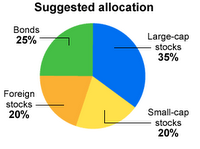
Asset Allocation GraphThe guide suggests certain funds: the "Indexes," and funds with low expense rations (basically, funds labelled "Small-Cap Value" or "Large-Cap Growth"). And it also suggests using a risk assessment calculator, which churned out the suggested allocation on the right.

Somehow, the fund performances in my company's 401(k) can't convince me to adopt these percentages. Instead, I've re-balanced to: 15% in large-cap stocks, 20% to small-cap and specialty stocks, and 45% in foreign stocks. (I hope markets outside the States keep it up!)

And that's my newly balanced and re-aligned 401(k). I'm also looking into a Roth IRA right now. (PTF)

Monday, September 11, 2006

Frugal is a Way of Life

What I do now:


Home...

  • Live with parents.
  • Use supermarket circulars.
  • Pick up change.
    When your jar fills up, take a friend to the bank with you...the free change sorter at Commerce makes for a fun trip. Especially if you win a prize for guesstimating within $1.99 of your total.
  • At-home manicures / pedicures.


Work...

  • A safe car with good gas mileage.
  • Group errands.
    e.g. going to the supermarket, library, or bank that's on the route home after work
  • Bring lunch to work.
  • Direct deposit paycheck.
  • Contribute to 401(k).
  • Automatic Savings Plans.


Other...

  • Use public library.
  • Pay credit cards in full each month.
  • Use cash rebate credit card.
    Only a good deal for those who don't carry balances! But I hear the 5% cash rebate days with Citi Dividend Platinum are over even though I haven't received any notices...I'm eyeing the Citi Professional now, but I'm still holding out "in case." (PTF)
  • Pay bills online.
    I made $5 signing up for online credit card statements...however, read the caveat in a later post! (PTF)
  • One "spending" ATM visit per month.
  • My shopping system. (PTF)
  • Buy clothes in basic colors.
  • Use digital camera.
  • "Family Plan" cell phone.

What I should do:

What I should do more:

  • Eat in.
  • Explore Salvation Army.
  • Invite friends to volunteer with me.
    We'd save $ together, get to spend time together, and worthy causes benefit - it's a win-win-win situation! (e.g. NY Cares)

There's no feeling more empowering than knowing that you are in control of your money...so I'm working on it!